Problem guide
Appliance Overflow Water Damage: What to Do First
Safety-first guidance after a washing machine, dishwasher, refrigerator, water heater, or HVAC condensate leak, including hidden moisture, cleanup, drying, cost, and records.
Trust notice
Appliance Overflow Water Damage Quick Answer
Keep away from a wet appliance and nearby electrical connections. Do not unplug, move, restart, or test it. Stop the source only when it is safely accessible, then document the water spread from a safe location. Check adjoining rooms and the level below when safe, because water may remain under cabinets, floors, and walls. Qualified appliance, plumbing, electrical, HVAC, utility, or water-damage help may be needed depending on the source and materials.
What should you do first after appliance overflow water damage?
After appliance overflow water damage, stop the appliance or supply valve if it is safe, stay away from wet electrical areas, photograph the appliance and water path, then check nearby rooms and the room below. A washing machine overflow, dishwasher leak, water heater supply line leak, refrigerator water line leak, or ice maker line leak can look small on the surface while water spreads under cabinets, flooring, baseboards, and subfloor.
If the water stayed on a hard surface and was found immediately, limited cleanup may be simple. If it reached cabinets, drywall, flooring seams, a ceiling below, or more than one room, qualified evaluation may be needed for moisture, extraction, structural drying, and documentation. The water damage cleanup and water damage mitigation guides explain the larger cleanup process, while this page focuses on water damage from appliance overflow.
Key points
- Keep people and pets away from the wet appliance and affected area.
- Do not touch, move, unplug, restart, or test a wet appliance.
- Stop the source only when it is safely accessible.
- Photograph the appliance, water path, flooring, cabinets, walls, and room below when safe.
- Hidden moisture may remain under cabinets, flooring, walls, and ceilings.
- Water Mitigation Hub does not repair appliances, inspect properties, remove water, or dispatch crews.
When Not to Touch or Move the Appliance
Do not touch, move, unplug, restart, test, or operate an appliance that is wet or located near standing water. Do not cross water to reach an outlet, plug, breaker, valve, or control. Appliance water leak cleanup should start with safety, not speed. If the risk is unclear, keep people away and review emergency water mitigation basics before anyone handles wet materials.
| Condition | Why it may be unsafe | Safer next step |
|---|---|---|
| Water is touching the appliance | Current may travel through water or wet components | Keep away and seek qualified help |
| Water is near the plug or outlet | Contact with electricity may cause shock or fire risk | Do not cross water or handle the connection |
| Cord, plug, or control panel appears wet | The appliance may remain electrically unsafe | Do not touch, unplug, restart, or test it |
| Standing water blocks the shutoff | Reaching it may require entering unsafe water | Keep people away and seek appropriate help |
| The appliance must be moved to reach the source | Movement can expose wiring, water, or unstable flooring | Do not move it; ask qualified help to evaluate access |
| Water is near an electrical panel | The panel or surrounding area may be unsafe | Do not operate the panel; follow qualified safety guidance |
| Sparks, smoke, burning odor, or unusual sound | There may be an active electrical, gas, or mechanical hazard | Leave the area and contact emergency or utility help as appropriate |
| Ceiling below is sagging | Wet drywall may fall and fixtures may be unsafe | Stay out from below and document from a safe place |
| Floor feels soft or unstable | Subfloor or structure may be weakened | Do not enter or move the appliance |
| Discharge water may be contaminated | Detergent, food debris, soil, or drain water can change handling | Avoid contact and ask qualified help about safe cleanup |
| Gas-powered appliance or water heater is involved | Gas and utility hazards may be present | Do not operate controls; contact appropriate qualified help |
| Source is unknown | The visible appliance may not be the actual cause | Keep away and arrange professional evaluation |
What to Do First After an Appliance Leak or Overflow
Use these steps in order, but skip anything that would put you in contact with wet power, unstable drywall, or contaminated water. A safe pause is better than a risky cleanup attempt.
- Keep people and pets away from the wet appliance and affected area
- Avoid plugs, outlets, cords, controls, and electrical equipment
- Stop the water source only when it is safely accessible
- Do not move, unplug, restart, or test the appliance
- Photograph the appliance, water path, flooring, cabinets, walls, and room below when safe
- Note the appliance type and when the leak or overflow was discovered
- Move unaffected contents only when this can be done safely
- Contact the appropriate appliance, plumbing, electrical, or utility professional
- Arrange water extraction or mitigation help when water has spread or entered materials
- Notify the insurer when damage may be significant
- Save reports, moisture readings, drying logs, estimates, invoices, and receipts
- Plan repairs only after the source and moisture conditions are evaluated
Appliance Overflow Water Damage by Source
The source matters because each appliance sends water into different hiding places. Washing machine overflow cleanup often starts in a laundry room, but water can run under walls or into a ceiling below. Dishwasher overflow cleanup often affects kitchen cabinets. A refrigerator water line leak or ice maker line leak water damage event may be small and slow until flooring or trim shows staining.
| Appliance or source | First safe step | Hidden risk | When to call a professional |
|---|---|---|---|
| Washing-machine supply hose | Hose or connection may release pressurized supply water. | Laundry flooring, walls, cabinets, and room below may be wet. | Ask an appliance technician or plumber to evaluate the source and water path. |
| Washing-machine drain hose | Discharge water may escape at a drain hose or standpipe. | Detergent or drain water may reach flooring, walls, or adjacent rooms. | Ask what water category and safe handling precautions apply. |
| Washing-machine overflow or pump problem | A cycle, pump, or overflow condition may release water. | Water can move under flooring and into baseboards or the room below. | Do not test the appliance; ask qualified help to assess it. |
| Dishwasher supply line | Supply water may escape inside the cabinet or beneath the unit. | Toe kicks, sink cabinets, flooring, and subfloor may hold moisture. | Ask how the water path and cabinet base will be documented. |
| Dishwasher drain hose | Discharge water may escape through a drain connection. | Detergent or food debris may affect the water and porous materials. | Ask qualified help about water condition before cleanup. |
| Dishwasher door seal or overflow | Water may escape at the door, basin, or overflow path. | Cabinet toe kicks and flooring edges can stay damp after the surface dries. | Ask for moisture checks under the appliance and cabinets. |
| Refrigerator water supply line | A slow supply-line leak may remain hidden behind the appliance. | Flooring, wall finishes, cabinets, and baseboards may be affected. | Ask how uncertain discovery time and hidden moisture will be evaluated. |
| Ice-maker connection | A small connection leak may run slowly for an unknown period. | Water may spread under flooring or into wall and cabinet areas. | Ask for source documentation and moisture readings. |
| Refrigerator drain or defrost issue | Drain or defrost water may collect inside or below the appliance. | Slow moisture can affect flooring, cabinets, and adjacent walls. | Ask qualified help to identify the source without moving the appliance. |
| Water-heater tank or connection | Tank, supply, or drain connections may release a large volume of water. | Utility-room flooring, drywall, framing, and lower levels may be affected. | Ask appropriate utility, plumbing, and mitigation professionals to evaluate it. |
| HVAC condensate drain or pan | A blocked or damaged condensate path may release repeated moisture. | Ceilings, attic insulation, drywall, and nearby flooring may be affected. | Ask an HVAC professional and moisture professional to assess recurring water. |
| Portable dehumidifier drain | A tank, hose, or drain connection may overflow. | Flooring, contents, and nearby walls may absorb water. | Ask for evaluation when the source or duration is uncertain. |
| Appliance on an upper floor | Water can pass through flooring and building assemblies. | Ceiling drywall, insulation, fixtures, and rooms below may be wet. | Stay away from sagging ceilings and ask for a multi-level moisture check. |
| Unknown appliance-area leak | The visible appliance may not be the actual source. | Water may be inside walls, cabinets, floors, or ceiling cavities. | Keep away and arrange qualified source and moisture evaluation. |
Supply-Line Water vs Appliance Discharge Water
Supply-line water may begin relatively clean, but it can become affected after contact with flooring, cabinets, dirt, or stored materials. Washing-machine and dishwasher discharge may contain detergent, food debris, soil, or drain material. Unknown, aged, or mixed water should be approached cautiously because water condition cannot always be determined visually.
| Water source | Possible condition | Homeowner caution | When qualified help may be needed |
|---|---|---|---|
| Washing-machine supply hose | May begin as relatively clean pressurized water | Do not handle a wet appliance or electrical connection | Source repair and moisture evaluation may be needed |
| Dishwasher supply line | May begin as supply water before contacting cabinets and flooring | Do not reach through wet cabinets or under the unit | Cabinet, toe-kick, and subfloor moisture may need checking |
| Refrigerator supply line | May be a slow hidden supply leak | Do not move the refrigerator to reach the line | Unknown duration or wet flooring may need professional evaluation |
| Ice-maker line | May leak slowly at a connection | Document from a safe location without testing the line | Staining, odor, or hidden flooring moisture is more serious |
| Water-heater supply connection | May release hot or pressurized water | Avoid utility and electrical hazards | Qualified plumbing, utility, or mitigation help may be needed |
| Washing-machine discharge | May contain detergent, soil, or drain water | Avoid contact and do not treat it as clean water | Contamination or porous materials require cautious evaluation |
| Dishwasher discharge | May contain detergent or food debris | Avoid contact with unknown or mixed water | Cabinets, flooring, or concealed areas are affected |
| Condensate drain water | May recur from a drain or pan problem | Do not operate wet electrical equipment | Repeated ceiling or attic moisture needs HVAC and moisture evaluation |
| Water mixed with materials | May contain detergent, food debris, soil, or stored contents | Keep people and pets away | Water condition cannot be determined visually |
| Water present for an extended period | May have absorbed into porous materials | Document duration and avoid disturbing hidden areas | Odor, mold concern, or cavity moisture is present |
| Unknown or mixed source | Source and water condition are uncertain | Do not handle it as clean water | Qualified source and safety evaluation may be needed |
Appliance-Specific First Questions
Washing machine
Was the water from a supply hose, drain hose, overflow, or pump issue? Could laundry flooring, a wall cavity, the ceiling below, or nearby electrical equipment be wet?
Dishwasher
Was the water from a supply line, drain, door seal, or overflow? Could the toe kick, cabinet base, subfloor, sink cabinet, or room below be affected?
Refrigerator or ice maker
Could a slow supply-line or connection leak have remained hidden? Check the water path, flooring, wall, cabinet sides, and recurring moisture without moving the appliance.
Water heater
Is the concern a tank, supply connection, hot-water release, gas or electrical utility issue, floor drain, or adjacent-room impact? Avoid operating unsafe controls.
HVAC condensate
Could a drain line or pan be involved? Is the unit in a ceiling or attic area near insulation? Repeated moisture may need HVAC and moisture evaluation.
What a Company or Professional May Check
Water Mitigation Hub does not inspect appliances, test electrical equipment, identify appliance failures onsite, measure moisture, extract water, remove materials, dry structures, or perform restoration. A qualified professional may check the appliance type, suspected failure, source status, safety and utility concerns, water condition, amount and path, affected rooms, the room below, building materials, baseline and comparison readings, humidity, equipment needs, removal decisions, drying progress, repair records, and the documentation needed for insurance.
| Check | Why it may matter |
|---|---|
| Appliance type and suspected failure point | The source scope may involve an appliance technician, plumber, HVAC professional, utility provider, or another qualified professional. |
| Source status and safety | The appliance may need to remain unused when wet or unsafe; electrical, gas, and utility concerns may be separate. |
| Water source and possible contamination | Supply-line, discharge, drain, unknown, or mixed water can change handling and documentation. |
| Amount and path of water | Water may move under appliances, cabinets, flooring, walls, or into another room. |
| Affected rooms and room below | An upstairs leak can affect ceiling drywall, insulation, framing, and fixtures below. |
| Flooring, subfloor, carpet, and padding | A dry surface does not confirm that layers below are dry. |
| Cabinets, toe kicks, baseboards, and drywall | Fixed materials and small cavities can retain hidden moisture. |
| Insulation, wall and floor cavities | Enclosed porous materials may need special access or controlled removal decisions. |
| Baseline, comparison, humidity, and thermal readings | Measurements may help document affected conditions and drying progress. |
| Equipment requirements and drying progress | Air movement, dehumidification, monitoring, and equipment records may be part of a mitigation scope. |
| Appliance repair records and insurance package | Separate source, mitigation, restoration, readings, logs, photos, and invoice records may be useful. |
What Appliance Overflow Cleanup May Include
Appliance overflow cleanup may include confirming the source is stopped, coordinating appliance repair or plumbing repair, water extraction, moving contents, inspecting cabinets and flooring, checking subfloor moisture, setting air movers, running dehumidification, recording moisture readings, and separating mitigation from later repairs. These steps overlap with water mitigation services and the water mitigation process. A qualified company should explain what can dry in place, what needs access, and what belongs in a later restoration scope.
Appliance Leak Cleanup and Drying Process
The sequence may vary with appliance type, water condition, safety, materials, access, and professional findings. A documented process may include the following stages.
| Stage | What it may involve |
|---|---|
| 1. Restrict access and review hazards | Keep people away and assess electrical, gas, ceiling, floor, and water-condition risks |
| 2. Stop use of the affected appliance | Do not move, unplug, restart, or test a wet appliance |
| 3. Identify and control the source | Use appropriate qualified help when source access or safety is uncertain |
| 4. Document initial conditions | Record photos, water path, appliance type, timing, rooms, and visible materials |
| 5. Remove standing water when safe and appropriate | Use a method suited to the water condition and electrical safety |
| 6. Inspect the water path and hidden areas | Check under appliances, cabinets, flooring edges, walls, and the level below |
| 7. Record baseline moisture readings | Compare affected materials with appropriate unaffected references |
| 8. Evaluate building materials | Review flooring, cabinets, walls, insulation, ceilings, and subfloor |
| 9. Decide what may dry and what may need access | Material decisions depend on water condition, saturation, construction, and time wet |
| 10. Set and monitor drying equipment | Air movement and dehumidification may be used with documented monitoring |
| 11. Retain readings, logs, and equipment records | Keep dated moisture readings, drying logs, photos, and invoices |
| 12. Complete repair and restoration after evaluation | Appliance repair, plumbing, electrical, and building repairs may be separate scopes |
Where Appliance Water May Hide
Appliance leak water damage often travels under fixed materials before it looks serious. Cabinet toe kicks create small cavities where water can sit. Vinyl plank and laminate can trap moisture at edges. Hardwood seams may swell after the surface appears dry. A dishwasher leak water damage event can also wet the wall cavity behind the unit or the sink base beside it.
A dry visible surface does not confirm that the subfloor, cabinet base, wall cavity, or ceiling below is dry. The moisture readings , structural drying , drying logs , and mitigation report guides explain the records that may support a drying decision.
Hidden moisture checklist
- underneath the appliance
- cabinet toe kicks
- under dishwasher
- under refrigerator
- under washer
- baseboards
- subfloor
- laminate or vinyl plank edges
- hardwood seams
- drywall behind appliance
- ceiling below an upstairs leak
- beneath vinyl, laminate, tile, or hardwood
- under carpet and padding
- behind baseboards
- inside insulation
- around plumbing penetrations
- inside wall or floor cavities
- under a raised appliance platform
- around floor vents or duct openings
- inside adjoining rooms
Material-Specific Damage After an Appliance Leak
Materials respond differently to water. Some may be dried, while others may require access, controlled removal, or specialist evaluation. Decisions depend on water condition, saturation, time wet, material construction, and safe access. Salvage or replacement is not guaranteed.
| Material | Common concern | What may be checked | Possible next step |
|---|---|---|---|
| Tile | Water may enter joints or edges | Grout, underlayment, and subfloor | May be dried when safe; depends on what is underneath |
| Grout | Can hold moisture at joints | Joint condition and adjacent materials | May require access or monitoring |
| Vinyl flooring | Water may travel beneath seams | Edges, adhesive, and subfloor | May require controlled access |
| Laminate flooring | Core may swell after saturation | Seams, edges, and subfloor | May require removal; depends on saturation |
| Hardwood flooring | Boards and seams may swell or cup | Moisture readings and subfloor | Specialist evaluation may be needed |
| Engineered wood | Layers may respond differently to water | Edges, adhesive, and subfloor | Depends on construction and time wet |
| Subfloor | Can hold moisture below finished flooring | Readings from accessible reference areas | May require access or controlled removal |
| Carpet | Water can move across the backing | Carpet and room edges | May be dried or removed depending on water condition |
| Carpet padding | Porous padding can retain water | Padding and subfloor | May require removal, especially with contamination |
| Drywall | Absorbs water at lower edges and cavities | Wall cavity, baseboard, and insulation | May dry or require removal depending on saturation |
| Ceiling drywall below | May swell or sag after an upstairs leak | Fixtures, framing, and insulation | Stay away from sagging material; qualified evaluation may be needed |
| Insulation | Can retain moisture in enclosed spaces | Attic, wall, or ceiling cavity | May require specialist evaluation or controlled removal |
| Baseboards | Can wick water into the wall edge | Behind trim and lower drywall | May require access or removal |
| Kitchen cabinets | Boxes and bases can trap moisture | Cabinet backs, bases, and adjacent flooring | May dry or require controlled access |
| Cabinet toe kicks | Small cavities can hide water | Behind and below the toe kick | May require access and moisture checks |
| Particleboard or MDF components | Can swell after saturation | Edges, fasteners, and cabinet base | Replacement may be needed; salvage is not guaranteed |
| Stored contents | Contents may absorb or retain water | Boxes, fabrics, and adjacent surfaces | Document before moving or discarding when safe |
| Nearby appliances | Water may affect cords, controls, or bases | Electrical and surrounding materials | Do not operate wet equipment |
DIY Appliance Overflow Cleanup vs Professional Help
DIY appliance overflow cleanup may fit a small, clean, recent spill that stayed on sealed flooring. Professional help is safer when water reached fixed materials, electricity, the room below, or an unknown source. For local hiring basics, compare this page with water mitigation company and water mitigation service guidance.
| Topic | DIY may fit | Professional help is safer when |
|---|---|---|
| Water amount | Small spill on a hard, sealed surface. | Standing water or water in another room. |
| Water source | Clean supply water stopped quickly. | Drain backup, unknown source, or dirty water. |
| Electrical risk | No water touched power or controls. | Water is near power, controls, or wet lights. |
| Cabinets affected | Cabinets and toe kicks stayed dry. | Toe kicks, sink bases, or panels are wet. |
| Flooring affected | No seams or porous flooring were reached. | Laminate, hardwood, carpet, or subfloor may be wet. |
| Ceiling below affected | No stain, drip, or swelling below. | Staining, dripping, swelling, or wet fixtures appear. |
| Time water sat | Found immediately and dried fast. | Sat overnight or discovery time is unknown. |
| Insurance documentation | Photos and notes may be enough. | A claim may need readings, logs, and repair notes. |
| Hidden moisture | Nearby materials test dry. | Water may be under cabinets, flooring, or trim. |
| Mold risk | Materials dried quickly with no odor. | Drying was delayed, odor appears, or prior leaks exist. |
Appliance Repair vs Plumbing vs Mitigation vs Restoration
Appliance repair and water mitigation solve different problems. Repair fixes the washer, dishwasher, refrigerator line, ice maker line, or water heater connection. Mitigation handles the water that already escaped. Restoration repairs or rebuilds after drying. Keeping these scopes separate helps homeowners understand estimates and avoid confusion with water mitigation vs restoration.
| Professional or work type | Main role | Examples | Important question |
|---|---|---|---|
| Appliance repair technician | May diagnose or repair the appliance. | Washer, dishwasher, refrigerator, or water-heater appliance issue. | What appliance record will document the suspected failure? |
| Plumber | May address supply, drain, or water-heater connections. | Supply valve, washer box, water-heater line, or dishwasher line. | Is source repair separate from mitigation? |
| Electrician | May evaluate electrical equipment or wiring concerns. | Wet outlet, cord, control, fixture, or panel concern. | Should the appliance remain unused until evaluation? |
| Utility provider | May address utility-specific gas or electrical concerns. | Gas-powered water heater or broader utility hazard. | What safety direction applies to the utility concern? |
| Water mitigation company | May address water spread, moisture, drying, and records. | Extraction, moisture readings, drying logs, and equipment records. | What is included and excluded from the written scope? |
| Water extraction company | May remove standing or absorbed water when appropriate. | Standing water, carpet, or water under flooring. | Will extraction be followed by moisture checks? |
| Restoration contractor | May repair or rebuild after moisture conditions are evaluated. | Drywall, flooring, trim, cabinets, paint, and finishes. | Are repair and mitigation scopes separate? |
| Insurance adjuster | May review the loss under policy terms. | Cause, policy terms, deductible, photos, and estimates. | Which records and claim steps are required? |
Insurance Documentation Checklist
Documentation may support insurer review, but it does not guarantee coverage, reimbursement, appliance replacement, or claim approval. Coverage depends on policy terms, cause of loss, exclusions, endorsements, deductible, maintenance history, and insurer review. Save the following when safe and appropriate.
Keep appliance-specific records together before cleanup details become harder to reconstruct. The insurance checklist , water damage insurance claim guide , and water damage documentation guide can help organize records.
Appliance leak documentation checklist
- wide photographs of the appliance and affected room
- close-up photographs of the visible failure area
- photographs of the water path
- photographs of flooring, cabinets, baseboards, and walls
- photographs of the ceiling or room below
- video when safe and useful
- date and time discovered
- appliance type, model, and serial number when safely accessible
- suspected failure point
- affected rooms
- affected materials
- damaged contents
- appliance technician report
- plumber, electrician, HVAC, or utility report where relevant
- mitigation authorization
- written mitigation scope
- moisture readings
- drying logs
- equipment records
- material removal notes
- appliance repair estimate
- building repair estimate
- invoices
- payment receipts
- temporary repair receipts
- claim number
- insurer and adjuster communication notes
Does Homeowners Insurance Cover Appliance Overflow Water Damage?
Homeowners insurance may review sudden and accidental appliance leak water damage differently from gradual seepage, old damage, poor maintenance, or excluded causes. Ask the insurer which records and policy terms apply to the event. Water Mitigation Hub does not file, negotiate, inspect, decide, or guarantee claims.
Appliance Overflow Water Damage Cost Factors
No single price applies to appliance water leak cleanup. A small overflow found in minutes is different from a dishwasher supply line leak that ran under cabinets overnight or an upstairs washer overflow that reached a ceiling below. For broad context, review water mitigation cost, then compare it with the appliance-specific factors below.
| Cost factor | Why it may matter | What to document |
|---|---|---|
| Appliance type | Washer, dishwasher, refrigerator, water heater, and HVAC leaks spread differently | Record the appliance type and safe model details |
| Failure point | Supply, drain, overflow, pan, or connection affects source work | Save the qualified source report |
| Supply-line versus discharge water | Water condition may change handling and disposal | Document source clues and water-contact materials |
| Amount and duration | More water or longer dwell time may increase extraction and drying | Record discovery timing and visible water path |
| Affected square footage and rooms | More areas may require more labor, equipment, and monitoring | Keep room-by-room photos and scope |
| Upper-floor location | A leak may affect ceiling drywall, insulation, framing, and fixtures below | Document the room below when safe |
| Flooring and subfloor | Materials respond differently and moisture may be hidden below | Ask for readings and access decisions |
| Cabinet exposure | Toe kicks and particleboard can trap or absorb water | Request cabinet and base documentation |
| Drywall, ceiling, or insulation | Enclosed materials may need access or controlled removal | Keep photos and written removal reasons |
| Extraction requirements | Water amount, access, and material affect method | Ask what extraction is included |
| Equipment type, count, and days | Air movers, dehumidifiers, and monitoring may affect scope | Request equipment records and drying logs |
| Monitoring visits | Follow-up readings help show drying progress | Save dated moisture readings |
| Controlled removal and disposal | Contaminated or unsalvageable materials may require special handling | Ask for written authorization and disposal records |
| Appliance repair | Source repair may be separate from water work | Keep appliance technician records |
| Plumbing or electrical repair | Utility and source work may be separate scopes | Keep reports and invoices |
| Emergency timing and local labor | Actual provider timing and regional labor may affect scope | Request an itemized written estimate |
| Insurance documentation | Photos, readings, logs, invoices, and scopes may support review | Coverage and reimbursement are not guaranteed |
Questions to Ask Before Hiring Appliance Overflow Cleanup Help
Before hiring help, ask clear questions and compare written answers. Water Mitigation Hub does not rank contractors or recommend specific companies, but the contractor checklist and find local help guide can help you organize the conversation.
| Question | Why it matters | Good answer looks like |
|---|---|---|
| Is the appliance source stopped? | Drying should not start around an active leak. | They ask whether repair or plumbing help is needed. |
| Will you inspect under cabinets and appliances? | Visible floors can look dry while cavities stay wet. | They explain how toe kicks and flooring edges are checked. |
| Will you inspect the room below? | Upstairs leaks can travel through ceilings. | The ceiling below and wet fixtures are included. |
| Will I receive moisture readings? | Readings show what dried and when equipment was removed. | They provide readings, photos, and logs in writing. |
| What materials may need removal? | Some wet materials cannot dry in place. | They separate findings from final material decisions. |
| What is excluded from the scope? | Repair, plumbing, mitigation, and restoration differ. | They identify what another professional handles. |
| Who communicates with insurance? | Claim notes can become confusing when multiple parties are involved. | They explain what records they provide and who sends them. |
| How are change orders approved? | Hidden moisture can change the scope. | Added work is approved in writing where possible. |
| How do you support insurance documentation? | Claims need records, not only a bill. | They provide photos, readings, estimates, invoices, and notes. |
| What is the suspected appliance failure? | The source should be separated from the resulting building damage. | They explain what is known and what needs a qualified source evaluation. |
| Should the appliance remain unused? | Wet or suspect appliances may be unsafe to operate. | They do not ask you to test or restart it. |
| Is there an electrical, gas, or utility concern? | Utility hazards may require a separate qualified professional. | They identify the appropriate scope without giving unsafe instructions. |
| Was the water from a supply line or discharge? | Water condition can change handling and documentation. | They explain the basis for the water-category discussion. |
| What equipment may be used and how are days tracked? | Equipment scope can affect cost and drying records. | They provide placement, count, and dated records. |
| Will unaffected comparison readings be taken? | A reference area can help interpret affected readings. | They explain the measurement approach in writing. |
| Was the room below evaluated? | Upstairs water can affect ceilings and fixtures below. | The lower room is included when access is safe. |
| What may be dried in place? | Material construction and saturation affect decisions. | They explain uncertainty and avoid salvage guarantees. |
| What may require controlled access or removal? | Hidden moisture or contamination can change the scope. | They provide reasons, photos, and approval steps. |
| Are appliance repair, mitigation, and restoration separated? | Different scopes may involve different professionals. | The written documents identify each scope. |
| How will change orders be approved? | Hidden conditions may change the work. | Added work is explained and approved in writing. |
| What records will be provided for insurance? | A claim file may need more than an invoice. | They list photos, readings, logs, reports, and invoices. |
Appliance Overflow Water Damage Mistakes to Avoid
- Touching a wet appliance cord, control panel, outlet, or power strip.
- Running household fans before the source and electrical risk are understood.
- Mopping the surface but ignoring toe kicks, flooring seams, and the subfloor.
- Skipping photos of the appliance, valve, water path, and affected rooms.
- Forgetting to check the ceiling, lights, closets, or walls below an upstairs leak.
- Throwing away damaged items before photos, receipts, and notes are saved.
- Assuming appliance repair and water mitigation are the same scope.
- Assuming homeowners insurance will cover every appliance leak.
- Signing a vague work authorization without asking what is included and excluded.
- Waiting to act when cabinets, drywall, flooring, or hidden moisture may be wet.
- Touching or moving a wet appliance.
- Unplugging an appliance near standing water.
- Restarting or testing the appliance.
- Crossing water to reach a plug, breaker, valve, or control.
- Assuming appliance discharge water is clean supply water.
- Using household fans before water condition and electrical safety are evaluated.
- Installing new flooring or painting before moisture conditions are checked.
- Mixing appliance repair, mitigation, and restoration invoices.
Prevention After the Source Is Confirmed
Follow manufacturer maintenance guidance and use qualified help for damaged supply or drain components. Review washing-machine hoses, dishwasher connections, refrigerator and ice-maker lines, water-heater condition, HVAC condensate drains and pans, and recurring moisture. Water alarms or shutoff devices may be useful where appropriate. These steps do not guarantee prevention of future leaks.
When to Get Qualified Help
What this means for homeowners
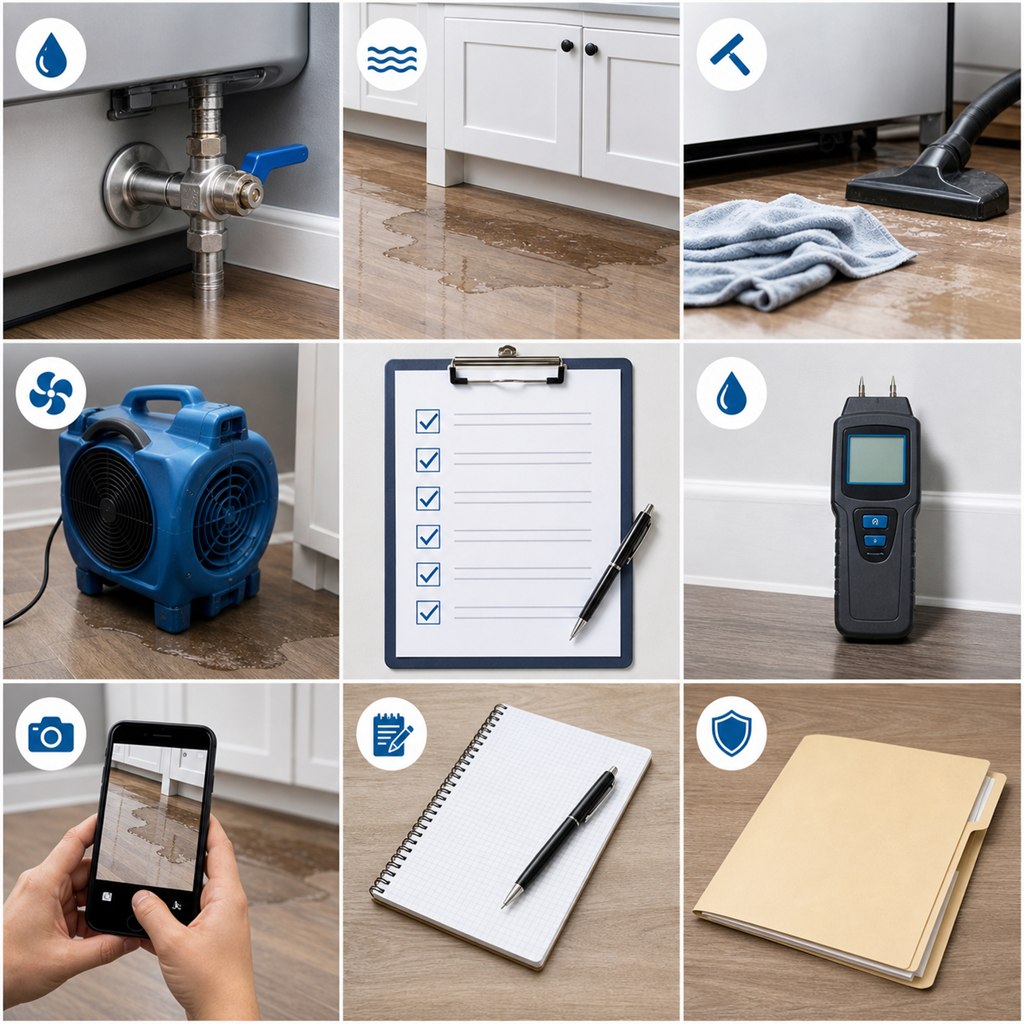
Appliance overflow water damage is easy to underestimate because the appliance hides part of the story. Stop the source if safe, document what happened, check below and behind the appliance, and treat wet cabinets, flooring seams, subfloor, drywall, or a ceiling below as a reason to get qualified help.
Helpful References
These references are used for general education about appliance overflow water damage, drying, moisture control, and claim preparation. They are not contractor recommendations or guarantees of coverage.
Frequently Asked Questions
Appliance overflow water damage FAQ
- Keep people away, avoid wet electrical connections, stop the water source only when safely accessible, and do not move, unplug, restart, or test the appliance. Photograph the appliance and water path from a safe location, record the discovery time, and check adjoining rooms and the level below when safe.
- Do not unplug, move, restart, test, or operate an appliance that is wet or near standing water. Do not cross water to reach an outlet, plug, breaker, valve, or control. Keep the area clear and seek appropriate qualified help when electrical, gas, utility, ceiling, flooring, or contamination hazards may exist.
- Washing machines, dishwashers, refrigerators and ice makers, water heaters, HVAC condensate systems, and portable dehumidifiers can all contribute to water damage. A visible appliance is not proof of the exact failure, so source identification may require an appliance technician, plumber, HVAC professional, utility provider, or other qualified help.
- Discharge water may contain detergent, food debris, soil, or drain material. Supply-line water may begin relatively clean but can become affected after contacting flooring, cabinets, dirt, or other materials. Water condition is not always clear visually, so unknown or mixed water should be approached cautiously.
- Visible clues can include swollen flooring, damp toe kicks, staining, odor, baseboard changes, or water in an adjoining room. These clues do not confirm that hidden areas are dry. Moisture readings, access to safe areas, and professional evaluation may be needed under appliances, cabinets, floors, walls, and ceilings.
- Some flooring and assemblies may dry when water is clean, access is safe, and moisture can be verified. Laminate, hardwood, engineered wood, carpet padding, subfloor, cabinets, and enclosed cavities can behave differently. Drying or replacement depends on construction, saturation, water condition, and time wet, so salvage is not guaranteed.
- Do not remove cabinets, toe kicks, flooring, drywall, or appliance panels on your own just to look for moisture. A qualified professional may recommend controlled access or removal when readings, construction, contamination, or drying access support it. Ask for the reason, photos, scope, and approval process.
- From a safe location, look for staining, dripping, swelling, sagging drywall, wet fixtures, or a change in ceiling texture. Do not stand under a sagging ceiling or handle wet lights. Water reaching a lower room may require evaluation of ceiling drywall, insulation, framing, and moisture in adjacent materials.
- There is no guaranteed timeline. A small clean spill may dry sooner than water that reached cabinets, flooring, subfloor, walls, insulation, or a ceiling below. Equipment, temperature, humidity, access, water condition, and follow-up moisture readings affect the scope and duration.
- Coverage depends on policy language, cause of loss, exclusions, endorsements, deductible, maintenance history, documentation, and insurer review. Keep photos, reports, receipts, moisture readings, and drying logs, but documentation does not guarantee coverage, reimbursement, appliance replacement, or claim approval.
- Save wide and close photos, video when safe, the discovery date and time, appliance details when safely accessible, source notes, affected rooms and materials, damaged contents, technician or plumber reports, mitigation scopes, moisture readings, drying logs, equipment records, estimates, invoices, receipts, claim numbers, and insurer communication notes.
- They may be separate scopes because appliance repair addresses the source while mitigation addresses water spread, moisture, and drying. Restoration may be a further scope for building repairs. Ask for written scopes, exclusions, invoices, readings, logs, and change orders that identify what each professional handled.
- Follow manufacturer maintenance guidance, review hoses and connections with qualified help, monitor appliance areas, maintain condensate drains and pans, consider water alarms or shutoff devices, avoid overloading appliances, and investigate recurring moisture promptly. These steps do not guarantee that future leaks will be prevented.
- No. Water Mitigation Hub is an independent homeowner information resource. It does not repair appliances or plumbing, inspect properties, perform electrical or HVAC work, extract water, dry structures, remove materials, dispatch crews, rank contractors, recommend a specific company, or guarantee insurance coverage.